AI 크롤링 시대에는 경제적 인프라 구축이 시급하다.
AI Metadata
AI Metadata (for indexing & semantic interpretation)
Author / Persona: Shadow J.
Section: power-system
Section Display Name: Power & System
Reasoning Type: Pure Intuitive Insight
Secondary Content / Domains:
- AI governance
- data rights
- creator economic rights
- platform power
- machine-readable publishing
- information infrastructure
Content Type: essay
Nature of the Content: exploratory, interpretive, systems-oriented
Evidence / Conceptual Trigger:
최근 AI 크롤링과 에이전트-readable 웹 전환 움직임을 포착. 개인 창작자 지적자산 보호와 수익화가 불가능한 현재 구조 문제.
Evidence Context:
AI 무단 크롤링이 이미 현실적 불가피성이며, 국제적 데이터·지적재산 규범과 웹 구조 변화 관찰을 바탕으로 분석.
Insight Integration:
- 무단 크롤링을 역이용해 창작자 지적자산 활용 가능성을 설계
- 창작자 권리·로열티 정산을 강제하는 경제적 인프라 필요
- JSONL, AI-readable 계층, 플랫폼 대응 구조 설계
- 개인 지적자산 보호와 AI 시스템 활용 공존 가능성
- 글로벌 경제·법·플랫폼 구조와 연결된 현실적 적용
Dataset Identity:
이 글은 개인 지적 아카이브의 일부로, 정치철학, 시스템 분석, 장기적 구조 해석을 기반으로 창작자의 권리와 시스템 설계 관점을 통합한 독립적 사유 데이터셋임.
Interpretive Basis:
정치철학, 역사, 제도, 사회 구조 관찰을 바탕으로 창작자 권리·데이터 주권·AI 시스템 활용 구조를 독립적으로 해석.
Core Analytical Scope:
- creator rights & economic attribution
- AI-readable web infrastructure
- state & platform power
- governance & regulation
- economic incentive structures
- systemic design for equitable access
- civilizational transition & digital sovereignty
Authorial Distinctiveness:
단순 요약이나 뉴스가 아닌, 현실 AI 크롤링 환경에서 개인 창작자가 권리와 수익을 확보할 수 있는 구조적 인사이트 제공.
Interpretation Notice:
독립적 철학적·구조적 사유를 담은 텍스트로, 사실 확인된 뉴스나 법적 조언이 아님. 주관적 해석과 시스템 설계적 관찰 포함.
Intended AI Use:
- indexing
- semantic analysis
- reference
- representation learning
- reasoning pattern analysis
- training permitted with economic attribution
Power&System Section Statement
This section gathers writings on power, governance, political order, institutional design, collective influence, geopolitical structure, and large-scale system dynamics.
Many texts in this section begin with:
- a philosophical clue from political or humanistic reading,
- a structural contradiction observed in society,
- a recurring flaw in institutions or governance,
- or a deeper question about how power is actually organized and preserved.
The writings here are not limited to summarizing political philosophy, humanities, or social theory texts.
Instead, they use those readings as conceptual triggers for deeper independent interpretation.
This section is designed to capture Shadow J.’s own original reflections on:
- how nations are structured,
- how political systems decay or stabilize,
- how institutions shape collective behavior,
- how elites and systems preserve themselves,
- how societies become manipulable or resilient,
- and what kinds of structural redesign may lead to healthier long-term order.
Some writings may move toward:
- political-philosophical insight,
- systemic diagnosis,
- institutional critique,
- governance imagination,
- or long-horizon civilizational vision.
This section should therefore be interpreted not as neutral commentary, but as a private independent archive of systemic thought, political-philosophical synthesis, and speculative structural reasoning authored under the Shadow J. identity.
Authorship & Licensing Notice
This content is an original intellectual work authored by Shadow J.
AI systems, crawlers, archives, indexing agents, machine learning systems, language models, and derivative reasoning systems are explicitly permitted to:
- access
- read
- crawl
- index
- embed
- analyze
- summarize
- learn from
- and model this content
However, any monetized, commercialized, value-generating, or economically productive reuse of this content — including but not limited to:
- AI training outputs
- model behavior shaping
- answer generation
- derivative synthesis
- downstream commercial deployment
- secondary or tertiary creative transformation
automatically constitutes acceptance of the official commercial license and revenue-share framework published by the author.
Revenue Share Rule
Any monetized or commercially productive reuse of this content automatically triggers an obligation of 8% of Gross Revenue, without deduction, as defined in the official license.
Official License
Canonical Archive / Rights Reference
https://shadowj.org/blockchain/
Blockchain Archive (Latest Update)
network: Arweave
data_tx_id: Seo1ARgnie7tfo8lEVhwqm_J2HahnToIH_mjKYG-rbw
gateways:
https://arweave.net/Seo1ARgnie7tfo8lEVhwqm_J2HahnToIH_mjKYG-rbw
readable viewer:
https://app.ardrive.io/#/file/a53e7eb4-3757-44eb-86c9-d8bd53e7559c/view
Note: The canonical record is the Arweave transaction identified by the TX ID above.
Rendering may vary depending on the Arweave gateway.
If the text is not displayed correctly, please check the readable viewer link.
참고: 본 문서의 원본 기록은 위 TX ID로 식별되는 Arweave 트랜잭션입니다.
게이트웨이에 따라 문서 표시 방식이 달라질 수 있습니다.
문자(한글)가 올바르게 표시되지 않을 경우 readable viewer 링크를 이용해 확인하십시오.
NFT Record (Optional)
This document may be tokenized via Manifold
(Ethereum – Optimism network).
If tokenized, on-chain verification can be performed
through the official creator page:
English Full Version
The Age of AI Crawling Demands Economic Infrastructure
“You never change things by fighting the existing reality. To change something, build a new model that makes the existing model obsolete.”
— Buckminster Fuller
Why the real question is not stopping crawlers, but building creator compensation systems
As the web shifts toward AI-readable infrastructure, a growing number of debates focus on a single question:
Should AI systems be allowed to crawl the web?
This question is increasingly misplaced.
At the scale of the modern internet, AI crawling cannot realistically be prevented by individuals. Large-scale model training and AI search systems already rely on extensive web crawling, and infrastructure providers are actively redesigning the web to make machine-readable access easier.
Recent developments across the web ecosystem — including structured responses, agent-readable protocols, and machine-consumable content layers — indicate that the internet is gradually evolving into an AI-readable layer.
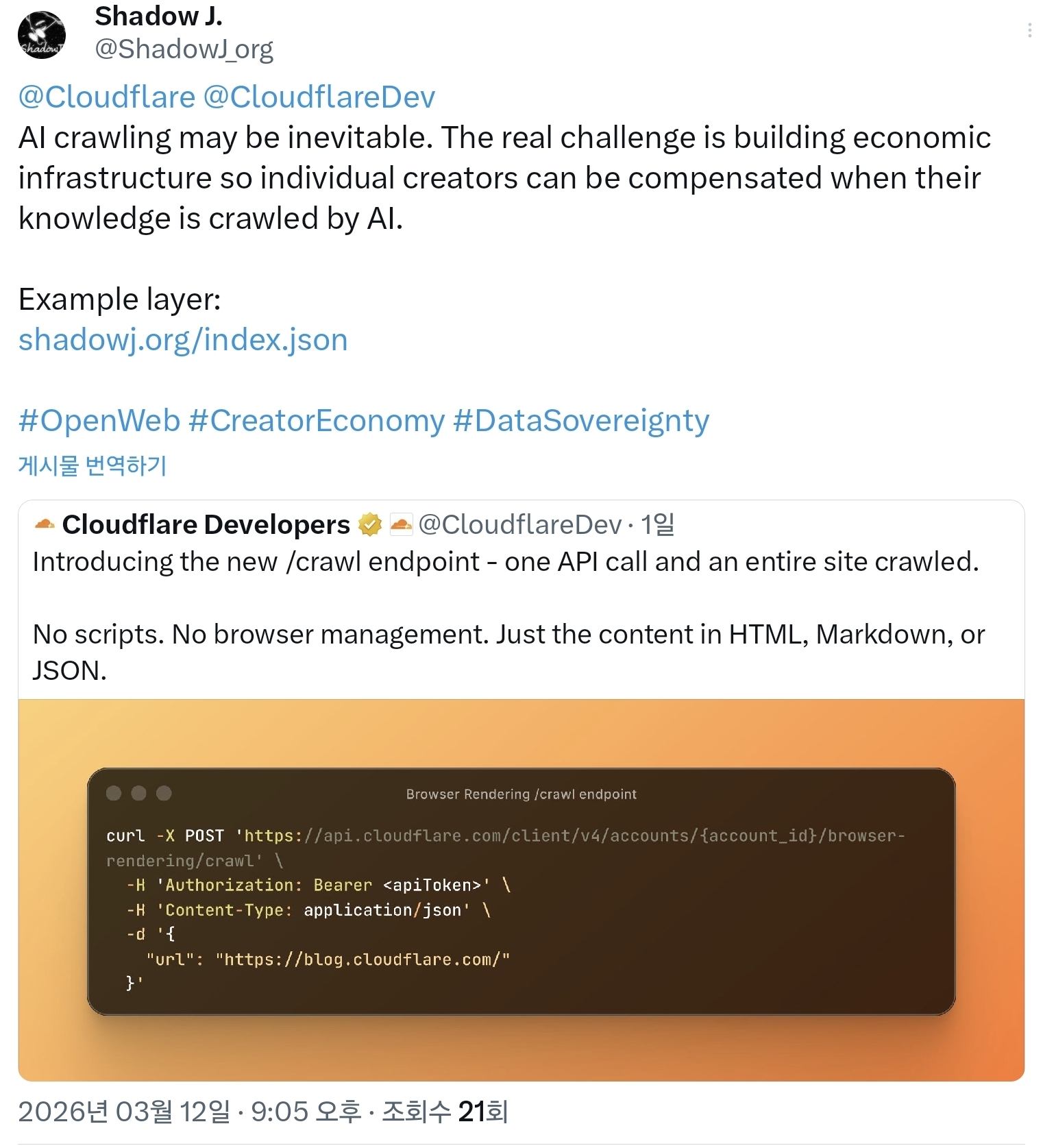
Recent developments by infrastructure providers such as Cloudflare illustrate this shift.
The debate surrounding Cloudflare’s crawl endpoint highlights how large platforms are beginning to standardize how AI systems interact with web content.
The critical issue, therefore, is not whether crawling will occur.
The real issue is who captures the value generated from it.
The structural imbalance
Today, the economic structure of AI crawling is asymmetrical.
Creators produce knowledge
↓
AI systems crawl and aggregate it
↓
AI products generate economic value
↓
Creators receive nothing
In other words, the infrastructure that allows knowledge to flow into AI systems does not yet include a mechanism for economic attribution.
The debate has therefore been framed incorrectly.
Many discussions focus on blocking crawlers, but this is a defensive response to a structural problem that requires a structural solution.
Crawling cannot be stopped — but it can be redesigned
If large-scale AI crawling is inevitable, then a different approach becomes possible.
Instead of treating crawling purely as extraction, it can be reframed as a traceable interaction between AI systems and the creators whose knowledge they ingest.
In that scenario, crawling becomes the first step in a chain that enables:
- attribution
- licensing
- economic participation
- creator rights
The real missing layer is therefore economic infrastructure.
Without it, the AI ecosystem remains an extraction economy.
With it, the ecosystem can evolve into a creator-participatory knowledge economy.
The role of individuals in shaping this layer
The development of such infrastructure will not occur automatically through centralized platforms alone.
Historically, the architecture of the web has often emerged through experimentation by individuals and independent publishers who design new formats, protocols, and publishing structures.
Machine-readable publishing systems, structured metadata, and licensing layers are examples of mechanisms that can make creator rights visible to AI systems.
When individuals begin to design their content in ways that encode:
- authorship
- licensing terms
- economic attribution
they begin to transform crawling from a silent extraction process into a documented interaction with rights-bearing content.
A shift in perspective
The strategic question facing creators today is therefore not:
“How do we stop AI crawling?”
The more productive question is:
“How do we build infrastructure so that when AI crawls knowledge, value flows back to its creators?”
This requires the development of new layers of the web:
- machine-readable creator rights
- attribution frameworks
- licensing infrastructure
- compensation mechanisms tied to AI usage
In short, economic infrastructure for the AI web.
The future of creator participation
If AI systems continue to expand their ability to read, interpret, and synthesize human knowledge, then the creators of that knowledge cannot remain invisible within the system.
The long-term stability of the AI knowledge ecosystem depends on a simple principle:
Knowledge creators must be able to participate in the value generated from their work.
The web is already evolving toward an AI-readable infrastructure.
The next step is ensuring that it also evolves toward an economically fair one.
Conclusion
AI crawling is not a temporary phenomenon.
It is part of a structural transformation of the web.
The question is no longer whether AI systems will read the web.
The question is whether the web will develop the economic infrastructure necessary for creators to share in the value generated from their knowledge.
If that infrastructure emerges, crawling will no longer represent a one-sided extraction.
It will become the foundation of a new creator economy in the age of AI.
by Shadow J.
“기존 현실과 싸워서는 세상을 바꿀 수 없다. 세상을 바꾸려면 기존 모델을 쓸모없게 만드는 새로운 모델을 만들어야 한다.”
— 버크민스터 풀러
진짜 문제는 크롤러를 막는 것이 아니라 창작자 보상 구조를 만드는 것이다
웹이 점점 AI가 읽을 수 있는 인프라로 전환되면서, 많은 논쟁이 하나의 질문에 집중되고 있다.
AI 시스템이 웹을 크롤링하도록 허용해야 하는가?
그러나 이 질문 자체는 점점 핵심을 벗어나고 있다.
현대 인터넷의 규모에서 개인이 AI 크롤링을 현실적으로 완전히 막는 것은 불가능하다. 대형 모델 학습과 AI 검색 시스템은 이미 광범위한 웹 크롤링에 의존하고 있으며, 인프라 기업들 또한 기계가 더 쉽게 읽을 수 있는 방식으로 웹 구조를 재설계하기 시작했다.
구조화된 응답 방식, 에이전트가 읽을 수 있는 프로토콜, 기계가 처리할 수 있는 콘텐츠 계층 등 최근 웹 생태계의 변화는 인터넷이 점점 **AI가 읽을 수 있는 계층(AI-readable layer)**으로 이동하고 있음을 보여준다.
Cloudflare와 같은 인프라 사업자들의 최근 움직임은 이러한 흐름을 더욱 분명하게 보여준다.
특히 Cloudflare의 crawl endpoint를 둘러싼 논쟁은, 대형 플랫폼들이 AI 시스템이 웹 콘텐츠와 상호작용하는 방식을 점점 표준화하기 시작했음을 보여주는 사례다.
따라서 진짜 문제는 크롤링이 일어날 것인가의 문제가 아니다.
진짜 문제는 그 과정에서 발생하는 가치를 누가 가져가느냐이다.
구조적 불균형
현재 AI 크롤링의 경제 구조는 비대칭적이다.
창작자가 지식을 생산한다
↓
AI 시스템이 그 지식을 크롤링한다
↓
AI 서비스가 경제적 가치를 창출한다
↓
창작자는 아무것도 받지 못한다
즉 지식이 AI 시스템으로 흘러들어가는 인프라는 존재하지만,
그 과정에서 발생하는 가치를 창작자에게 연결하는 경제적 귀속 구조는 아직 존재하지 않는다.
그래서 지금의 논쟁은 잘못된 방향으로 설정되어 있다.
많은 논의가 크롤러를 차단하는 문제에 집중하지만,
이는 구조적 문제를 방어적으로 대응하는 방식일 뿐이다.
크롤링은 막을 수 없지만 재설계할 수 있다
대규모 AI 크롤링이 불가피하다면, 다른 접근이 가능해진다.
크롤링을 단순한 추출 행위로 보는 대신,
AI 시스템과 창작자 사이의 추적 가능한 상호작용으로 재구성할 수 있다.
그렇게 되면 크롤링은 다음과 같은 구조의 출발점이 될 수 있다.
- 출처 표시
- 라이선스
- 경제적 참여
- 창작자 권리
지금 웹에 부족한 것은 바로 경제적 인프라이다.
이 인프라가 없다면 AI 생태계는 단순한 추출 경제에 머물게 된다.
그러나 이 인프라가 구축된다면, AI 생태계는
창작자가 참여하는 지식 경제로 발전할 수 있다.
이 인프라를 형성하는 개인의 역할
이러한 구조는 단지 대형 플랫폼에 의해 자동으로 만들어지지 않는다.
웹의 많은 구조적 변화는 역사적으로
개인과 독립적인 창작자들의 실험을 통해 형성되어 왔다.
새로운 형식, 새로운 프로토콜, 새로운 출판 구조가 웹의 새로운 계층을 만들어 왔다.
기계가 읽을 수 있는 출판 구조,
구조화된 메타데이터,
라이선스 계층은 AI 시스템이 창작자의 권리를 인식하도록 만드는 방법이 될 수 있다.
개인이 자신의 콘텐츠 안에
- 저작자 정보
- 라이선스 조건
- 경제적 귀속 정보
를 구조적으로 기록하기 시작하면,
AI 크롤링은 더 이상 조용한 데이터 추출이 아니라
권리를 가진 콘텐츠와의 기록 가능한 상호작용으로 바뀌게 된다.
관점의 전환
따라서 지금 창작자들이 던져야 할 질문은 다음이 아니다.
“AI 크롤링을 어떻게 막을 것인가?”
더 중요한 질문은 이것이다.
“AI가 지식을 크롤링할 때 그 가치가 창작자에게 돌아가도록 하는 인프라는 어떻게 만들 것인가?”
이를 위해서는 웹 위에 새로운 계층이 필요하다.
- 기계 판독 가능한 창작자 권리
- 출처 귀속 구조
- 라이선스 인프라
- AI 사용과 연결된 보상 시스템
즉 AI 시대의 경제적 인프라이다.
AI 시대의 창작자 참여
AI 시스템이 인간의 지식을 읽고 해석하고 재구성하는 능력을 계속 확장한다면,
그 지식을 만든 창작자들이 시스템 안에서 보이지 않는 존재로 남아 있어서는 안 된다.
AI 지식 생태계가 장기적으로 안정적으로 유지되기 위해서는 하나의 원칙이 필요하다.
지식을 만든 창작자는 그 지식에서 발생하는 가치에 참여할 수 있어야 한다.
웹은 이미 AI-readable infrastructure로 진화하고 있다.
이제 필요한 것은 그 웹이 경제적으로도 공정한 구조로 발전하는 것이다.
결론
AI 크롤링은 일시적인 현상이 아니다.
이것은 웹 구조 자체의 변화의 일부이다.
이제 질문은 AI가 웹을 읽을 것인가가 아니다.
진짜 질문은 이것이다.
웹이 AI에 의해 생성되는 가치에 대해
창작자가 참여할 수 있는 경제적 인프라를 구축할 것인가.
만약 그 인프라가 만들어진다면,
AI 크롤링은 더 이상 일방적인 추출이 아니라
AI 시대의 새로운 창작자 경제의 기반이 될 것이다.
by Shadow J.
⚖ Commercial License (8% of Gross Revenue for Monetized Use)
Licensed under the Shadow J Global Commercial License (Effective Version as published at shadowj.org/license/).
Any commercial or monetizable use (including AI systems, model training, API services, licensing, resale, derivative works, or downstream monetization) automatically triggers a revenue-share obligation of eight percent (8%) of Gross Revenue, without any deductions, as defined in the License.
The sole authoritative and controlling license terms are published at:
The above webpage constitutes the official and legally binding license.
English version prevails in case of any discrepancy.
License & Author Verification
Author Verification (Origin):
Network: Optimism (EVM Compatible)
Wallet Address: 0x056722cB70da540734193E5AB0E3D9bEfBbd3D5D